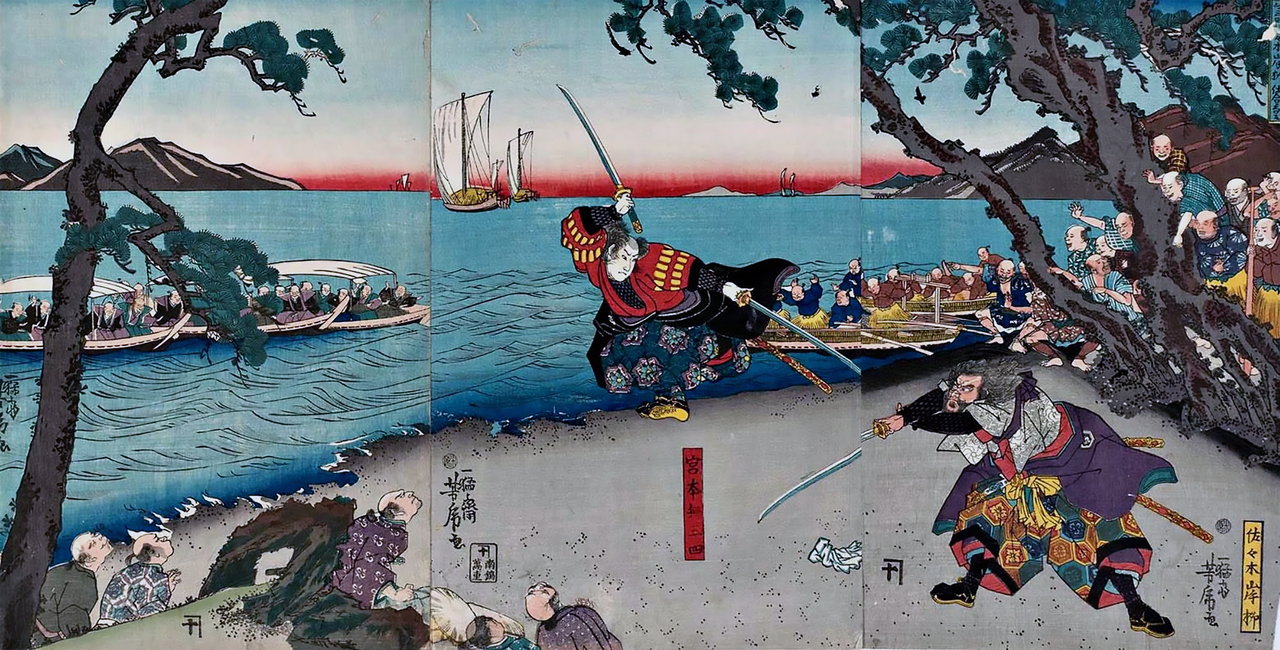
On April 13, 1612, a famed swordsman slept past the agreed upon time for his duel to the death. This match, one of the most famous in Japanese history, was fought on a small island in the southwest of Japan. On one side was Ganryu Sasaki Kojiro, the sword instructor of the local daimyo, and the other was Miyamoto Musashi, legendary swordsman and later writer of the Book of Five Rings.
According to the Nitenki, a historical document of the events, On that day a crowd of supervisors had gathered at Funajima, now called Ganryujima, to watch a duel between two renown combatants. At the agreed upon time, Sasaki Kojiro and his entourage waited in full formal dress under the hot sun, while Musashi crawled out of bed and casually took a boat to the island.
Kojiro, famous for using a sword as long as a “Drying Pole”, was furious that he had been kept waiting for so long under the beating sun. He felt disrespected. This anger grew even more when he noticed that Musashi wasn’t using a standard weapon, but rather one of the boat’s spare oars that he had carved into a weapon–to be slightly longer than Kojiro’s own blade. This must have angered Kojiro further, as he dramatically unsheathed his sword and threw it into the waves.
Musashi is said to have seen this action and replied, “You’ve lost, Kojiro. Only the loser will have no need for his scabbard.”
He was correct.
While the story is often told as a demonstration of Musashi’s mastery of psychological warfare, we can learn another lesson from it: Had Kojiro been able to process his anger and frustration, keeping him from fighting angrily, the result may have been different.
Out mental states affect our performance as much as our physical states do. The mind and body is connected.
In the martial arts, improve our bodies so we can be indominable by physical pressure, but we often neglect our mental training. An untrained mental can become a vulnerability in a world where physical conflict is rare, but psychological pressure is common. As martial artists aiming to reach our potential, we must engage in the mental development that makes us mentally indominable. If Kojiro had the mental training, then perhaps the psychological tactics of Musashi would not have affected him. He would have been able to fight at his best, and perhaps history would have passed down a different tale.
This is the mission of training the Mental Martial Arts. Just as we seek physical strength so that we are not simply dominated by others, we seek mental understanding and control so that we can perform at our best–unhindered by the trials and challenges of the world.
To learn more about the effects of anger, proceed to the next article.
(2026.06.06) Note about scholarly accuracy:
The Account of the Duel written here is drawn from the book “The Lone Samurai” by William Scott Wilson and “Musashi: Life and Writings” by Kenji Tokitsu (translated by Sherab Chodzin Kohn).I understand that this depiction of the events was heavily influenced by the most popular account from the Nitenki. The Nitenki (二天記) was a biography of Miyamoto Muashi was written in 1776 by Toyodo Kagehide, the chief retainer of the Hosokawa family (who employed Kojiro) and a master of the Niten Ichi-ryu (Musashi’s art) school of swordsmanship for the Matsui family.
As with much of Musashi’s life, a great deal of his life has been mythologized, and there is a great deal of historical debate about the actual events that transpired on the day of the duel. If you’re curious about the controversies, I recommend reading the book “Miyamoto Musashi: His Life and Writings” by Kenji Tokitsu. Tokitsu takes a scholarly approach and goes over the differing accounts of the events, and the frankly messier circumstances that transpired.
Leave a Reply